The Car Maintenance Schedule That Actually Prevents Failures
Maintenance schedules exist because a small number of cheap, scheduled actions prevent a small number of very expensive failures. That is the whole logic, and it means not all maintenance is equally important. Some items on a shop's menu genuinely protect the engine; others are revenue with a plausible story attached.
This guide separates them by consequence: what happens if you skip it. An oil change skipped repeatedly destroys an engine. A cabin air filter skipped indefinitely makes the car smell. Both appear on the same service menu at similar prices, and knowing which is which is worth thousands over the life of a car.
Every 5,000–10,000 miles: oil and filter
Modern synthetic oils and modern engines genuinely stretch further than the old 3,000-mile rule, and most manufacturers now specify 7,500–10,000 miles for normal service. Follow your manufacturer's number, not the sticker a quick-lube shop put on your windshield, which is frequently more conservative than the engineering requires.
The important nuance is 'severe service', which sounds like it means towing through deserts and actually describes: short trips under 10 miles, extensive idling, stop-and-go traffic, extreme cold or heat, and dusty conditions. A large share of ordinary commuters qualify, and severe-service intervals are typically half the normal ones. If your driving is mostly short urban trips, use the shorter number.
Use the specified viscosity, not a close approximation. Modern engines with variable valve timing route oil through fine passages to operate the timing actuators, and the wrong grade causes real, diagnosable faults — VVT codes are among the most common consequences of 'close enough' oil.
Every 15,000–30,000 miles: filters and inspection
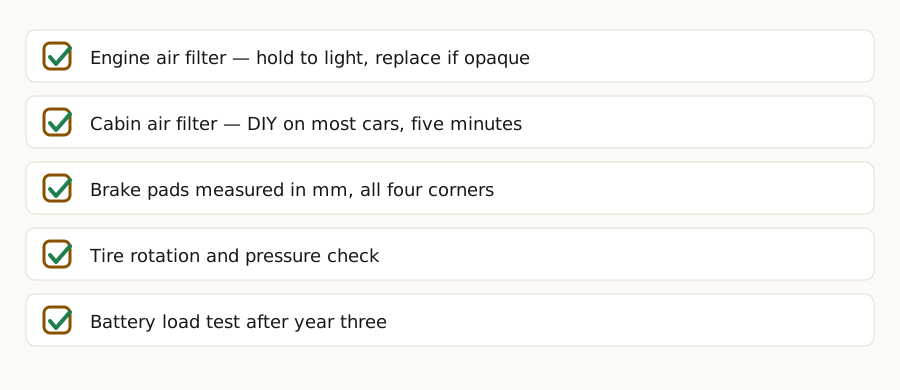
Engine air filter: cheap, easy, and genuinely affects economy and power when badly clogged. You can check it in two minutes — hold it up to light. If light does not pass through, replace it.
Cabin air filter: comfort rather than mechanical health, but it is a five-minute job on most cars and shops charge $60–$100 for it. This is the single most worthwhile DIY item on the list for pure cost-saving.
Brake inspection: pad thickness measured in millimetres, rotor condition, and — the part people forget — caliper slide pins, which seize and cause uneven wear. Catching a sticking caliper before it destroys a rotor is exactly the kind of saving inspections exist for.
Every 30,000–60,000 miles: the fluids that protect expensive parts
Brake fluid. It absorbs moisture from the air over time, which lowers its boiling point and eventually gives you a soft pedal after repeated hard braking. Most manufacturers specify replacement every two to three years regardless of mileage. This one is genuinely safety-relevant and genuinely skipped by almost everyone.
Transmission fluid. The most common expensive omission in car ownership. Automatic transmissions are hydraulic machines whose fluid is also a friction material — it degrades, and degraded fluid causes the shudder and slip that eventually becomes a rebuild. Follow the manufacturer's interval; if yours claims 'lifetime fluid', understand that the lifetime in question is the warranty period.
Coolant. Modern long-life coolants run 5–10 years, but they do expire, and depleted corrosion inhibitors quietly eat water pumps, radiators and heater cores. Replacing coolant is cheap; replacing a heater core means removing a dashboard.
The timing belt: the one interval you must not miss
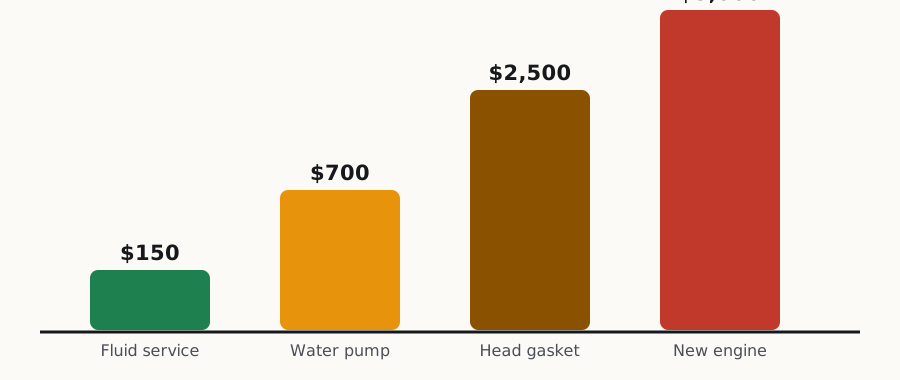
If your engine has a timing belt rather than a chain, the replacement interval — typically 60,000 to 105,000 miles or 7–10 years — is the most consequential number in your service book. On an interference engine, a snapped belt lets pistons hit valves, and the repair bill approaches or exceeds the value of many cars.
The belt costs relatively little; the labour dominates, because reaching it means dismantling the front of the engine. Which is exactly why the water pump, tensioner and idlers should be replaced at the same time if they are driven by that belt. Doing them together costs a little more in parts and saves the entire labour bill a second time.
Find out which your engine has. Belt or chain is a two-minute lookup, and the answer determines whether you have a hard deadline or not.
What shops oversell
Engine flushes on a well-maintained engine. Fuel injector cleaning as routine maintenance rather than as a response to a symptom. Nitrogen tire fills. Undercoating on a new car. 'Premium' fluid upgrades that exceed manufacturer specification without a reason tied to how you drive.
None of these are frauds exactly; each has a scenario where it makes sense. What makes them oversold is being presented as scheduled maintenance when they are not in your manufacturer's schedule. The test is simple and completely fair to ask: 'is this in the manufacturer's schedule for my car, or is it a shop recommendation?' Both answers are acceptable — you just deserve to know which one you are getting.
Tools that make this easier
Affiliate links — we may earn a commission at no extra cost to you. How this works.
Lisle Adjustable Oil Filter Wrench
The one tool that turns an oil change from a wrestling match into a routine job. Filters get torqued on by heat cycles and hand strength is rarely enough. Cheap, lasts forever, and fits a wide range of filter sizes.
Best for: DIY oil changers
Check price on AmazonTEKTON 1/2-Inch Drive Click Torque Wrench
If you ever change a wheel, this is the difference between doing it correctly and warping a brake rotor or stripping a stud. Wheel nuts have a specified torque for a reason, and 'tight as I can make it' is not it. Also the first tool that makes other DIY jobs safe to attempt.
Best for: Anyone who changes their own wheels
Check price on AmazonTorin Big Red Steel Jack Stands (3 Ton Pair)
A jack lifts a car; it does not hold one. Nobody should ever be under a vehicle supported only by a jack, and this is the cheapest safety equipment in car ownership. Buy the pair, use them on solid level ground, and chock the wheels.
Best for: Anyone doing any work under a car
Check price on AmazonAntifreeze Coolant Tester Hydrometer
Reads your coolant's freeze protection in about ten seconds. Cheap insurance before winter, because coolant that is too diluted can freeze and crack a block — a repair that ends most cars. Also flags coolant that is simply old and needs replacing.
Best for: Cold-climate owners and anyone topping up with water
Check price on AmazonQuestions people ask
Is the 3,000-mile oil change dead?
For modern engines running full synthetic, largely yes — manufacturers now specify 7,500–10,000 miles for normal service and their engineering is what backs the warranty. The exception is severe service, which includes a lot of ordinary short-trip city driving, where halving the interval is genuinely justified rather than paranoid.
What happens if I skip transmission fluid?
Nothing, for a long time — and then a shudder at highway cruise, then hard shifts, then slipping. Degraded fluid loses both its hydraulic properties and its engineered friction characteristics, and the debris from slipping clutches circulates and accelerates everything. It is the classic case of a $200 service protecting a $3,000 repair.
Does dealer servicing keep my warranty valid?
In the US, no — the Magnuson-Moss Warranty Act means a manufacturer generally cannot void your warranty simply because an independent shop did the maintenance. What matters is that the specified service was performed on schedule with the specified fluids and parts, and that you kept the receipts. Keep every invoice.