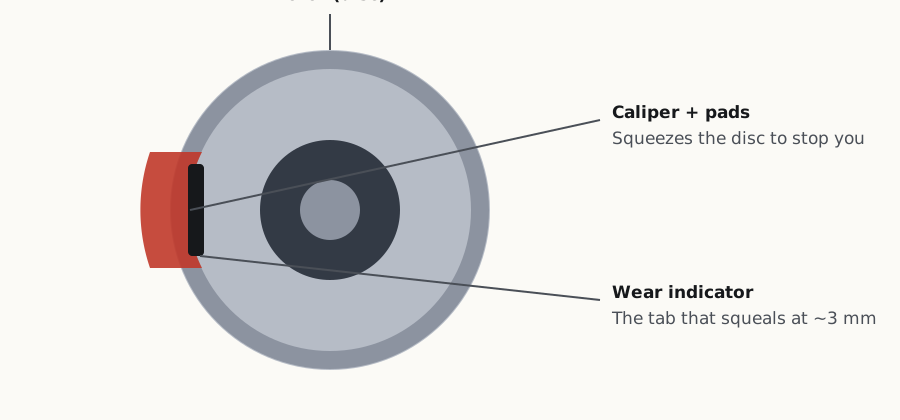
A squeal is a warning. A grind is the warning being over. When brake pads wear all the way down, the steel backing plate they were bonded to presses directly against the rotor, and what you hear is that plate machining a groove into the disc at every stop. The change from squeal to grind usually happens over a week or two, which is why so many grinding-brake cars arrive at the shop with a bill roughly double what it would have been a month earlier.
There are gentler causes — a pebble caught in the caliper, surface rust after a rainy week parked outside — and they have tells, covered below. But the honest base rate is that grinding under braking is worn-out pads until proven otherwise, and it is one of the few symptoms where waiting actively multiplies the cost.
What causes grinding when braking?
Cost bands are broad US independent-shop estimates, parts and labour. Dealers run higher; your car and region move the numbers.
What can I check myself?
- Note when it grinds. Only under braking points to pads; constant while rolling points to debris or a bearing; first few stops of the day only points to surface rust.
- Look through the wheel spokes at the pad. If you can see less than about 3 mm of friction material between the metal backing and the rotor — or no gap at all — the pads are done.
- After a normal drive, hold the back of your hand near each wheel (do not touch the rotor). One wheel radiating far more heat than the rest suggests a dragging caliper.
- Run a finger across the rotor face through the spokes when cold. Deep circular grooves you can catch a fingernail in mean the discs are already being cut.
What should I tell the mechanic?
- Ask for pad thickness in millimetres on all four corners, not just “they're low.”
- Ask whether the rotors are above minimum thickness — it is stamped on the disc — and whether they can be machined instead of replaced.
- If one side wore much faster than the other, ask why. Uneven wear means a sticking caliper or slide pins, and new pads alone will not fix it.
- Get parts and labour priced separately, and ask to see the old pads when you collect the car.
Describe what it’s doing in your own words and the symptom checker gives you a safe-to-drive verdict, ranked causes with costs, and notes to take to the shop — free, no sign-up.
Tools that make this easier
Affiliate links — we may earn a commission at no extra cost to you. How this works.
TEKTON 1/2-Inch Drive Click Torque Wrench
If you ever change a wheel, this is the difference between doing it correctly and warping a brake rotor or stripping a stud. Wheel nuts have a specified torque for a reason, and 'tight as I can make it' is not it. Also the first tool that makes other DIY jobs safe to attempt.
Best for: Anyone who changes their own wheels
Check price on AmazonTorin Big Red Steel Jack Stands (3 Ton Pair)
A jack lifts a car; it does not hold one. Nobody should ever be under a vehicle supported only by a jack, and this is the cheapest safety equipment in car ownership. Buy the pair, use them on solid level ground, and chock the wheels.
Best for: Anyone doing any work under a car
Check price on AmazonStreamlight Stylus Pro LED Flashlight
Your phone's torch drains the battery you may badly need, and it is awkward to hold while working. A proper compact light with a clip lives in the glovebox and works in the rain. Unglamorous and genuinely useful at 6am in a car park.
Best for: Glovebox essential
Check price on AmazonQuestions people ask
How long can I drive with grinding brakes?
Treat it in trips, not weeks: get it to a shop and stop there. The pads are gone, so braking performance is reduced and fading fast, and every stop is machining the rotors. What is a pads-and-rotors job today can become a caliper and hub job if the backing plate digs deep enough.
Why does it grind only at low speed?
Low-speed, light-pressure stops let the backing plate chatter against the rotor instead of biting evenly, which makes the grind more audible. It is the same metal-on-metal contact — the speed just changes the sound, not the severity.
Can grinding brakes be something cheap?
Yes, twice: a trapped stone and surface rust. Both have clean tells — the stone grinds while rolling even off the brakes, and rust clears completely within the first mile of driving. If it grinds specifically when you press the pedal and keeps doing it, it is pads.