How to Not Get Ripped Off at the Mechanic: A Practical Defence
Most people imagine getting ripped off looks like being charged $900 for a $400 job. In practice it far more often looks like being charged a fair price for work you did not need. The invoice is honest, the labour rate is normal, the part was genuinely installed — and none of it fixed anything, because the diagnosis was a guess.
That distinction matters, because it changes the defence. Price-checking protects you from overcharging. Only questions protect you from unnecessary work. This guide covers the specific patterns, what to say, and — importantly — which 'upsells' are actually legitimate advice that you should probably take.
What unnecessary work do shops add most often?
The bundled fluid flush. Power steering, brake, coolant and transmission flushes get added to unrelated repairs constantly. Some are genuinely due by interval. The test: ask whether they tested the fluid or are recommending it by mileage, and ask to see the manufacturer's interval for your car. Brake fluid has a real moisture test; if they did one, they can show you the result.
The premature catalytic converter. A P0420 code makes an expensive part the headline suspect, but a lazy downstream oxygen sensor and a small exhaust leak set the same code. Ask what was ruled out. A shop that measured sensor response and pressure-tested the exhaust has earned the sale; a shop that read one code and quoted $2,000 has not.
Engine and fuel-system cleaning services. Occasionally helpful on a genuinely carbon-loaded direct-injection engine. Frequently sold as routine maintenance to cars that do not need it, at $150–$300 a time.
'While we're in there'. Sometimes this is legitimate and money-saving — replacing a water pump during a timing belt job is genuinely smart, because you pay the labour once. Sometimes it is padding. The question that separates them: 'does doing this now save me labour later, or is it just convenient?'
What should I ask a mechanic?
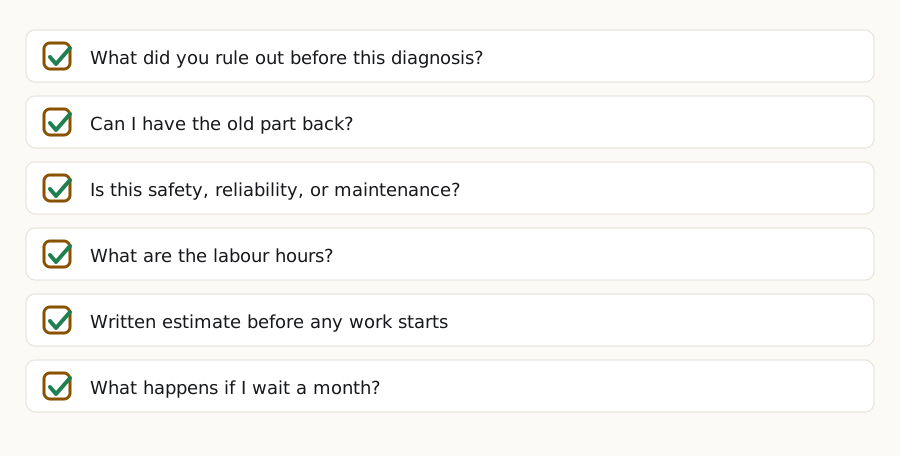
'What did you rule out before landing on this?' This is the single most valuable sentence in this guide. It cannot be answered vaguely, it signals you know diagnosis is a process, and it is completely polite.
'Can I have the old part back?' Ask before the work starts. In many states you have a legal right to it. The effect is immediate and well documented: work that was not going to happen tends to become unnecessary.
'Is this safety, reliability, or maintenance?' Forces triage. Safety means now. Reliability means it will strand you eventually. Maintenance means schedule it. A shop that calls everything safety-critical has told you something useful about itself.
'Can you put that in writing with the labour hours?' Verbal quotes drift. Written ones do not, and in many jurisdictions a written estimate limits how far the final bill can exceed it without your approval.
Which mechanic recommendations are actually worth taking?
Not every recommendation is a scam, and reflexive suspicion costs money too. Timing belts are the clearest example: on an interference engine, a snapped belt destroys the engine, and the replacement interval is not negotiable marketing. Refusing it because it feels expensive on a car that runs fine is one of the most expensive mistakes in car ownership.
Others worth taking seriously: brake fluid replacement on a car that has never had it (fluid absorbs moisture, which lowers its boiling point and gives you a soft pedal on long descents), a wheel bearing that is already audible, and any suspension component with actual visible play. When a shop shows you the movement under a pry bar, they are not selling — they are proving.
What are the red flags that mean I should leave?
Refusing to provide a written estimate. Refusing to return your old parts without explanation. Discovering multiple unrelated urgent problems during a routine service, especially on a car with no symptoms. Pressure framed as danger — 'I wouldn't let my daughter drive this' — applied to something that is not safety-critical.
And the specific one worth naming: being told the car is unsafe to drive off the lot, so you cannot get a second opinion. Occasionally true. Frequently a trap. If the claimed fault is brakes or steering, ask them to show you the specific component and what makes it unsafe. If it is anything else, a car that drove in usually drives out.
How do I find a mechanic I can trust?
The best long-term protection is boring: find an independent shop before you have an emergency, take routine work there, and become a known face. Shops treat regulars differently — not out of sentiment, but because a customer worth five years of business is worth more than one inflated invoice.
Look for shops with ASE-certified technicians, a written warranty on parts and labour (12 months/12,000 miles is a common baseline), and a willingness to explain. The willingness to explain is the strongest single signal. A technician who is glad to show you the worn part and describe why it matters is telling you they expect the relationship to continue.
Tools that make this easier
Affiliate links — we may earn a commission at no extra cost to you. How this works.
ANCEL AD310 Classic OBD2 Scanner
The glovebox tool. Wired, no app, no pairing, no batteries — plug it in and it reads and clears engine codes. This is the one that saves you a diagnostic fee the first time the check engine light comes on. Its limits are honest: engine codes only, no ABS or airbag, no live graphing.
Best for: Anyone who just wants to know what the light means
Check price on AmazonTEKTON 1/2-Inch Drive Click Torque Wrench
If you ever change a wheel, this is the difference between doing it correctly and warping a brake rotor or stripping a stud. Wheel nuts have a specified torque for a reason, and 'tight as I can make it' is not it. Also the first tool that makes other DIY jobs safe to attempt.
Best for: Anyone who changes their own wheels
Check price on AmazonTorin Big Red Steel Jack Stands (3 Ton Pair)
A jack lifts a car; it does not hold one. Nobody should ever be under a vehicle supported only by a jack, and this is the cheapest safety equipment in car ownership. Buy the pair, use them on solid level ground, and chock the wheels.
Best for: Anyone doing any work under a car
Check price on AmazonQuestions people ask
Is it rude to get a second opinion?
No, and any shop that treats it as an insult has answered a different question for you. Second opinions are standard practice for large repairs, and most good shops will say so unprompted. For anything over roughly $1,000 — especially transmissions, engines and catalytic converters — a second opinion is simply due diligence.
What if I already paid for work that didn't fix the problem?
Go back first, calmly, with the invoice. Reputable shops will re-diagnose without charging again, because they would rather fix it than lose you. If they refuse and you believe the diagnosis was negligent, your escalation path is a written complaint, then your state consumer protection office or attorney general, then small claims. Keep every invoice and note dates and names — documentation is most of what wins these.
Do women get quoted higher prices at repair shops?
Research over the years has repeatedly found gaps in quoted prices depending on how much knowledge the customer appears to have, and studies have found gender differences in some scenarios — with the effect shrinking when the customer signals they know the going rate. The practical takeaway for anyone: naming a specific expected price, or asking for labour hours, measurably changes the quote you get.