What Car Repairs Actually Cost: A Realistic 2026 Price Guide
Nobody walks into a repair shop knowing what a water pump should cost, and that asymmetry is the entire problem. The shop does this fifty times a week; you do it once every few years. This guide closes some of that gap — not with a single national number pretending to be precise, but with the ranges, the labour maths, and the questions that let you judge a quote yourself.
One structural thing to understand before any number: a repair bill is parts plus labour, and labour is usually the larger half. Labour is billed at an hourly rate — commonly $90–$200 depending on where you live and whether you are at a dealer — multiplied by a 'book time' that manufacturers publish for each job. That book time is fixed regardless of how fast the technician actually works. Once you know the rate and the book hours, you can sanity-check almost any quote.
How is a repair bill actually built?
Every quote has three components: parts, labour, and shop supplies or fees. Parts get marked up — 25–50% over the shop's cost is standard practice and not a scandal; it covers warranty risk and the time to source them. A 200% markup on a part you can price online in ten seconds is a different conversation.
Labour is rate × book time. If a shop charges $140/hour and the book time for a front brake job is 1.5 hours, the labour is $210 regardless of whether their technician finishes in 50 minutes. This is standard across the industry and it is not dishonest — it protects you when a rusted bolt turns a one-hour job into three.
Shop supplies fees of 5–10% of labour are common and usually legitimate; a flat 'diagnostic fee' of $80–$180 is also normal and frequently credited toward the repair if you proceed. What you should push back on is a diagnostic fee charged twice for the same fault, or supplies fees that scale with parts rather than labour.
What should common car repairs cost?
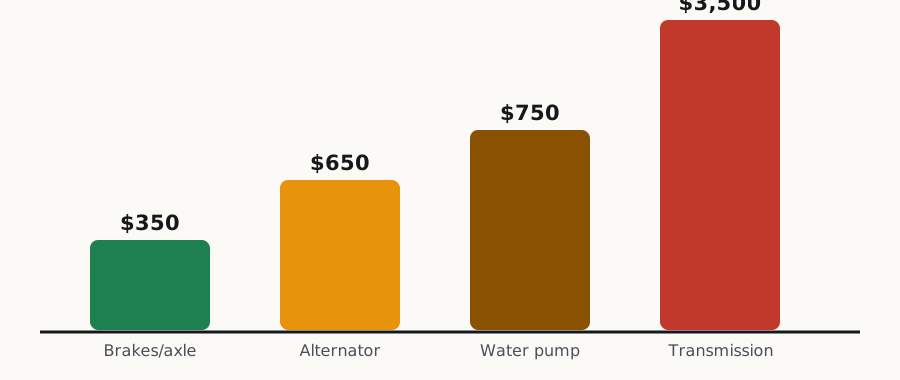
Brake pads and rotors, one axle: $350–$700. Pads alone run $180–$400. The gap is the difference between catching a squeal and waiting for a grind — if you act during the squeal phase, the rotors are often still above minimum thickness and can stay on the car.
Battery: $150–$350 fitted. Straightforward on most cars; some European models mount the battery in the boot and require registering the new battery to the charging system, which adds labour and is not upselling.
Alternator: $450–$900. The part is $200–$450 and access dominates the labour. Ask for the charging voltage reading (13.8–14.6V is healthy) before agreeing — a corroded ground strap can mimic a failed alternator perfectly.
Water pump: $400–$1,100. The spread is enormous and it is all about drive type: a belt-driven pump on an accessible engine is a modest job, while a timing-chain-driven pump means dismantling the front of the engine. If yours is timing-driven and the belt is near its interval, doing both at once saves paying the same labour twice.
Starter: $350–$800. Again, access. Some are an hour; some require removing the intake manifold.
Catalytic converter: $900–$2,800. The single most over-diagnosed expensive part in car repair. A P0420 code alone is not a converter verdict — ask what was ruled out first.
Transmission rebuild or replacement: $2,500–$5,000+. The widest quote spread in the entire industry, which is exactly why this is the repair where a second opinion at a transmission specialist pays for itself most reliably.
Why does the same job cost so differently?
Three variables explain nearly all quote variation. Geography: labour rates in a coastal metro can be double a rural midwest shop. Vehicle: German luxury cars genuinely take longer for the same nominal job because of packaging and required calibrations. And parts tier: OEM, premium aftermarket, and economy aftermarket can differ threefold on the same component.
None of these are dishonesty. What is worth challenging is being quoted the OEM part price without being told an aftermarket option exists, or being billed dealer book time at a shop that quoted an independent's hourly rate. Ask which tier of part is being quoted and whether an alternative exists — for many components, quality aftermarket parts are made in the same factories as OEM.
What questions keep a repair quote honest?
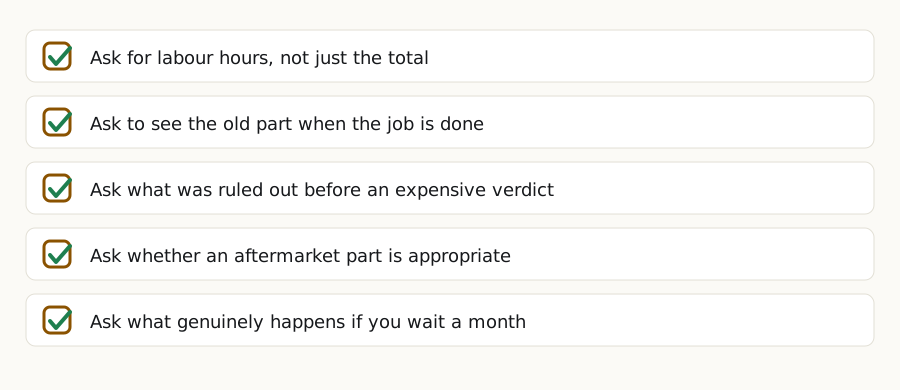
What are the labour hours on this job? This single question changes the conversation, because it signals you understand how the bill is built.
Can I see the old part? You are entitled to ask, and in many states entitled to receive it. Honest shops expect the question and are pleased to answer it.
What did you rule out before landing here? Especially important for expensive parts with cheap impostors — catalytic converters, transmissions, and anything diagnosed from a single code.
Is there an aftermarket option, and what does it change? Sometimes the answer is a legitimate 'no, use OEM for this one', and that answer is worth hearing too.
What happens if I wait? A good shop distinguishes safety-critical from convenience clearly. A shop that says everything is urgent is telling you something about itself.
Where does the money actually go wrong?
The expensive mistakes in car ownership are rarely a single overcharge. They are cheap faults left to become expensive ones: a squeal that becomes a grind, an overheat that becomes a head gasket, a slipping transmission that becomes a rebuild, a misfire that becomes a catalytic converter. In every one of those pairs, the first repair is a few hundred dollars and the second is four figures.
The second pattern is paying for parts instead of diagnosis. A $120 diagnostic that names the failed component is almost always cheaper than $400 of replaced parts that did not fix it. When a shop wants to 'start with' replacing something, ask what test would confirm it first.
Tools that make this easier
Affiliate links — we may earn a commission at no extra cost to you. How this works.
ANCEL AD310 Classic OBD2 Scanner
The glovebox tool. Wired, no app, no pairing, no batteries — plug it in and it reads and clears engine codes. This is the one that saves you a diagnostic fee the first time the check engine light comes on. Its limits are honest: engine codes only, no ABS or airbag, no live graphing.
Best for: Anyone who just wants to know what the light means
Check price on AmazonBlueDriver Bluetooth Pro OBD2 Scanner
Pairs with your phone and reads far more than engine codes — ABS, airbag, transmission and HVAC on most vehicles — plus live data. The real feature is the repair reports, which map a code to the fixes that most often resolved it on your specific year, make, model and engine. No subscription.
Best for: Owners keeping a car past warranty, or checking used cars
Check price on AmazonTEKTON 1/2-Inch Drive Click Torque Wrench
If you ever change a wheel, this is the difference between doing it correctly and warping a brake rotor or stripping a stud. Wheel nuts have a specified torque for a reason, and 'tight as I can make it' is not it. Also the first tool that makes other DIY jobs safe to attempt.
Best for: Anyone who changes their own wheels
Check price on AmazonQuestions people ask
Are dealer repairs always more expensive?
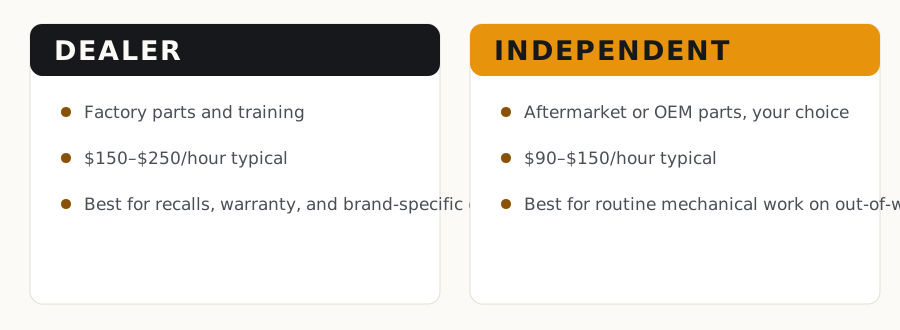
On labour rate, almost always — dealers commonly charge $150–$250 per hour against $90–$150 at independents. But for recall work (free), warranty work (free), and brand-specific electronic faults where dealer diagnostic tools matter, the dealer can be both cheaper and better. The honest rule: routine mechanical work at an independent, brand-specific electronics and anything under warranty at the dealer.
Should I buy my own parts and have a shop fit them?
Many shops decline, and their reasoning is sound: they cannot warranty a part they did not supply, and if your part fails they eat the labour to do the job twice. Some will fit customer-supplied parts at a higher labour rate or with no warranty. It can save money on expensive components, but understand you are taking on the risk that the part is wrong or defective.
How do I know if a quote is fair without another shop?
Three checks you can do from your phone: look up the part price online to sanity-check the markup, ask for the labour hours and multiply by a plausible local rate, and search the job plus your exact vehicle to see what others paid. If the quote is more than roughly 30% above what those three suggest, it is worth a second opinion — and getting one is normal, not rude.