Used Car Inspection: The Checks That Find the Expensive Problems
Buying a used car is the one moment where an hour of checking is worth thousands of dollars. Everything in this guide can be done by someone with no mechanical background, in a seller's driveway, with a phone and a cheap scanner. None of it requires getting under the car.
The organising idea is that expensive problems leave cheap evidence. Head gaskets leave residue under the oil cap. Neglected transmissions leave burnt-smelling fluid on a dipstick. Cleared fault codes leave incomplete readiness monitors. Accident repairs leave mismatched panel gaps. You are not diagnosing the car — you are looking for the fingerprints of the four or five failures that would cost you the most.
What should I check before I go see the car?
Ask for the VIN before you drive anywhere, and run two free checks. First, open recalls: the manufacturer and NHTSA both let you look up unrepaired safety recalls by VIN at no cost, and an open recall is both a bargaining point and a free repair you can claim after purchase.
Second, look up the model's complaint and investigation history. If hundreds of owners of that exact year and model reported the same transmission or engine failure, you want to know that before you fall in love with the car. This is public data, it is free, and almost nobody checks it.
A paid history report adds title status, reported accidents and odometer records. Worth the money on a car you are seriously considering — but understand its limits: it only knows what was reported, and plenty of accident repairs never appear.
Why does a cold start matter when buying a used car?
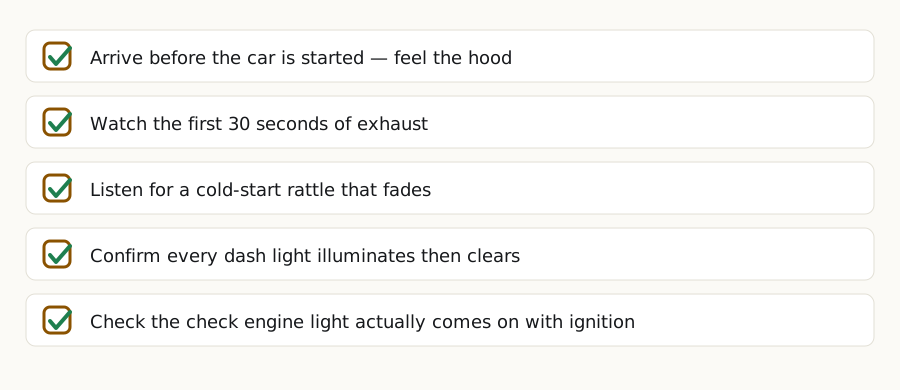
Insist on arriving before the car has been driven, and put your hand on the hood when you get there. A warm engine on a car that has supposedly been sitting is a warning sign in itself, because the cold start is when problems announce themselves: blue smoke from valve seals, a rattle from a stretched timing chain, a starter that hesitates, a battery at the end of its life.
Watch the exhaust for the first thirty seconds. Listen for a two-second rattle that fades — that is a timing chain tensioner story on many engines. Watch the dashboard as the lights cycle: every warning lamp should illuminate briefly and then go out. A lamp that never illuminates at all may have been removed from the cluster, which is a specific and deliberate kind of dishonesty.
What do the fluids tell you about a used car?
Oil: pull the dipstick. Honey-to-dark-brown is normal. Black and gritty means overdue changes. Then open the oil filler cap and look underneath — a milky, mayonnaise-like film can indicate coolant mixing with oil, which is a head gasket conversation and a reason to walk away from most private sales.
Coolant: look in the reservoir when cold. It should be a clear bright colour. Rusty brown, oily film on the surface, or a sludgy texture all mean neglect or worse. Transmission fluid, if the car has a dipstick: red to pink and nearly odourless is healthy; dark brown with a burnt smell means the transmission has been overheated and its future is uncertain.
Brake fluid: it should be light amber, not dark. Dark brake fluid means it has never been changed, which is both a safety item and a useful signal about the rest of the car's maintenance history.
What does an OBD2 scanner reveal on a used car?
Plug in a basic OBD2 reader. Obviously you are checking for stored codes — but the more revealing check is I/M readiness monitors. If the monitors are incomplete on a car that has supposedly been driven regularly, someone probably cleared codes recently, and the most common reason to do that right before a sale is to hide a check engine light.
A car with a cleared computer and a seller who says it has 'never had any problems' has just told you something. Ask directly whether the battery was disconnected recently. The answer, and how it is delivered, is information.
What should I feel for on the test drive?
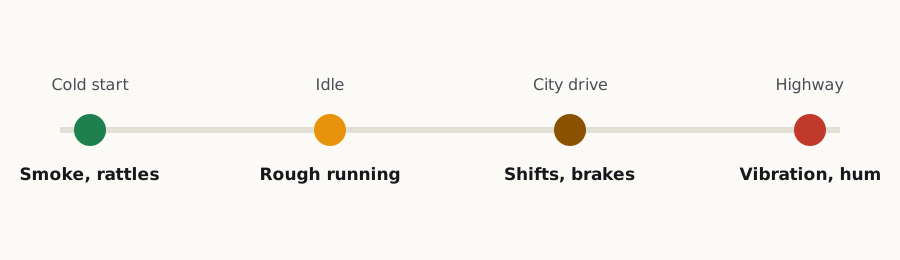
Find a flat, straight, quiet road and briefly let go of the wheel: the car should track straight. Pulling means alignment, tires, or a brake dragging. Brake firmly from about 45 mph — the pedal should be firm and high, with no pulsing through the wheel and no pull to either side.
Get to highway speed and note any vibration and exactly where you feel it. Then, in an empty area, weave gently and listen for a hum that changes with the weave — that is a wheel bearing. For automatics, pay attention to every shift: flaring revs between gears, thumps, or a shudder at steady cruise around 40–60 mph are all transmission warnings that matter enormously to the price.
Test everything electrical while you drive: every window, the air conditioning (does it get genuinely cold?), the heater, the infotainment, every light. Electrical faults are individually small and collectively expensive.
Is a pre-purchase inspection worth the money?
Everything above is free and catches a lot. A pre-purchase inspection at an independent shop costs roughly $100–$200 and catches what you cannot see: frame damage, rust in structural areas, leaking components on the underside, suspension play, and brake and tire measurements in actual numbers.
If a private seller refuses a pre-purchase inspection at a shop of your choosing, that refusal is your answer. Legitimate sellers of good cars agree to this routinely, because a clean report helps them sell. On a $12,000 car, $150 to know what you are buying is not an expense — it is the cheapest part of the transaction.
Tools that make this easier
Affiliate links — we may earn a commission at no extra cost to you. How this works.
ANCEL AD310 Classic OBD2 Scanner
The glovebox tool. Wired, no app, no pairing, no batteries — plug it in and it reads and clears engine codes. This is the one that saves you a diagnostic fee the first time the check engine light comes on. Its limits are honest: engine codes only, no ABS or airbag, no live graphing.
Best for: Anyone who just wants to know what the light means
Check price on AmazonBlueDriver Bluetooth Pro OBD2 Scanner
Pairs with your phone and reads far more than engine codes — ABS, airbag, transmission and HVAC on most vehicles — plus live data. The real feature is the repair reports, which map a code to the fixes that most often resolved it on your specific year, make, model and engine. No subscription.
Best for: Owners keeping a car past warranty, or checking used cars
Check price on AmazonAstroAI Digital Tire Pressure Gauge
Tiny, cheap, and it prevents the most common preventable car problem there is. Your dashboard TPMS tells you when something is already wrong; a gauge lets you check before it is. Pressure drops roughly 1 psi per 10°F, which is why winter catches so many people out.
Best for: Everyone — it costs less than one tank of fuel
Check price on AmazonStreamlight Stylus Pro LED Flashlight
Your phone's torch drains the battery you may badly need, and it is awkward to hold while working. A proper compact light with a clip lives in the glovebox and works in the rain. Unglamorous and genuinely useful at 6am in a car park.
Best for: Glovebox essential
Check price on AmazonQuestions people ask
What's the single biggest red flag on a used car?
Refusal to allow a cold start or an independent pre-purchase inspection. Both are reasonable requests that cost a genuine seller nothing, so refusing either usually means something is being managed. After that: milky residue under the oil cap and burnt-smelling transmission fluid, both of which point at four-figure repairs.
Are dealer-certified used cars worth the premium?
Sometimes. What you are buying is an inspection standard and an extended warranty, and the value depends entirely on the specific programme's terms — coverage length, what is excluded, and the deductible. Read the actual warranty document rather than the badge. A certified car with a thin warranty is just a used car with a sticker.
How many miles is too many?
Mileage matters far less than maintenance history and how the miles were accumulated. A 120,000-mile highway car with complete records is usually a better bet than a 60,000-mile car that did short urban trips and missed services. Ask for receipts; a folder of invoices is worth more than a low number on the odometer.