Why Cars Fail: The Patterns Manufacturers Don't Advertise
When an engine or transmission fails at 90,000 miles, the owner usually experiences it as bad luck. Frequently it is not. It is a pattern — the same component failing the same way across hundreds of thousands of vehicles, documented in complaint databases, discussed in owner forums, sometimes acknowledged in a quiet warranty extension, and occasionally ending in a recall or a class action.
This is not a conspiracy claim. Cars are built to cost and to deadlines, and every design is a set of trade-offs made with imperfect information. But the practical consequence for an owner is worth stating plainly: before you buy a used car, and before you spend four figures repairing one, it is worth knowing whether your failure is a known pattern. The data to find out is public and free.
How does a systemic car defect develop?
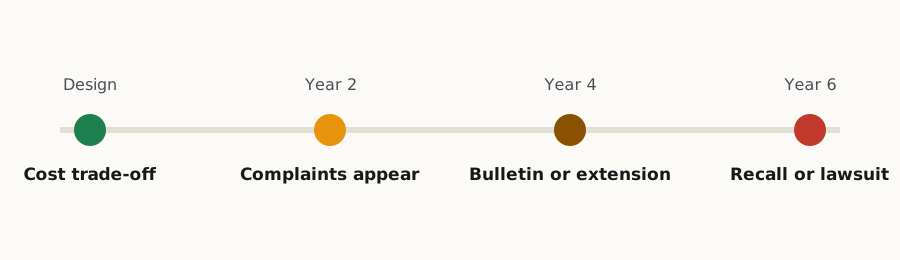
It usually starts with a cost or packaging decision that is reasonable in isolation. A plastic component replaces a metal one to save weight and money. A timing chain is specified with a tensioner design that is fine within its assumed oil-change interval. A transmission is calibrated for fuel economy targets that keep it in a marginal operating window. None of these are negligent on the drawing board.
The failures appear years later, at mileages beyond warranty, under real-world conditions that differ from the test assumptions — owners who stretch oil changes, climates hotter than modelled, driving patterns that load a component differently. By the time the pattern is visible in the field, millions of vehicles are already built and sold.
What happens next is where owner outcomes diverge. Some manufacturers issue extended warranties covering the specific component. Some publish service bulletins with revised parts. Some do nothing until regulators or litigation force the issue.
Which failures repeat across manufacturers?
Timing chain stretch. Chains were supposed to be lifetime components; in engines with marginal tensioner designs or long oil intervals, they stretch, throwing cam-crank correlation codes and eventually skipping teeth. The early warning is a two-second rattle at cold start.
Direct injection carbon buildup. Port injection washed intake valves with fuel; direct injection does not, so on many engines carbon accumulates on the valves and causes misfires and rough running at high mileage. Some manufacturers added a port injector back specifically to solve this.
Dual-clutch and CVT durability. Both technologies deliver real efficiency gains, and both have produced cohorts of vehicles with shortened service life under stop-and-go use they were not optimised for.
Coolant intrusion and gasket materials. Gasket compounds that harden faster than expected in specific engine bays produce a predictable population of coolant leaks at similar mileages.
Plastic in the cooling system. Plastic thermostat housings, radiator end tanks and water pump impellers save weight and cost, and become brittle with heat cycling on a fairly predictable schedule.
Where can I find known problems for my exact vehicle?
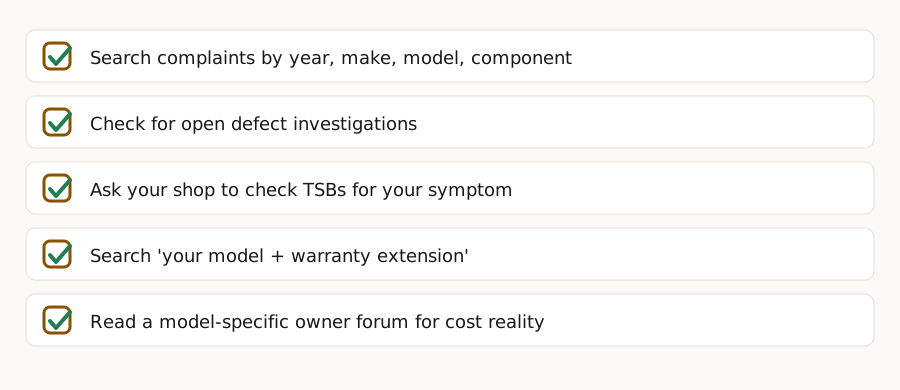
Owner complaint databases. Complaints filed with safety regulators are public and searchable by year, make, model and component. This is the earliest and richest signal available — hundreds of owners describing the same failure in their own words, with mileages. Sort by component to see what a given vehicle actually breaks.
Open investigations. When regulators open a formal defect investigation, that is a strong public signal that a pattern has crossed a threshold. Investigations often precede recalls by a year or more.
Technical service bulletins. The manufacturer's own instructions to dealers about known issues and the correct repair. If your symptom matches a TSB, the diagnosis is effectively done — ask your shop to check.
Warranty extensions and customer satisfaction campaigns. Quiet acknowledgements that a component fails early. They are often not advertised to owners who have not complained, which is exactly why looking them up is worthwhile.
Owner forums for your specific model. Unscientific but frequently the fastest route to 'is this normal for this car', including the practical detail of what the repair actually cost people.
What do I do if my failure is a known pattern?
First, document it. Dates, mileages, symptoms, every invoice. Documentation is most of what determines outcomes in every escalation path that follows.
Then check whether a warranty extension or campaign covers it — if it does, the repair may be free or heavily subsidised even well outside the original warranty. Escalate past the dealer to the manufacturer's customer service line if needed; dealers do not always volunteer campaigns they are not asked about.
Even with no formal programme, manufacturers sometimes offer 'goodwill' assistance on known-pattern failures, particularly for owners with service history at franchised dealers. It is worth asking directly and politely, in writing, with your documentation attached. And if a class action has been certified for your defect, check whether your vehicle is included and what the claim deadline is — those deadlines pass quietly.
How do I use this before buying a car?
This is where the knowledge is worth the most money, because it is entirely preventative. Before buying any used car, spend twenty minutes: search complaints for that exact year and model, look at which components dominate, check for open investigations, and search the model name with words like 'common problems' and 'known issues'.
What you are looking for is not perfection — every vehicle has complaints. You are looking for concentration: one component, hundreds of reports, similar mileages. That is a pattern, and it tells you what to inspect, what to ask about, and whether the price should reflect a repair that is probably coming.
Tools that make this easier
Affiliate links — we may earn a commission at no extra cost to you. How this works.
BlueDriver Bluetooth Pro OBD2 Scanner
Pairs with your phone and reads far more than engine codes — ABS, airbag, transmission and HVAC on most vehicles — plus live data. The real feature is the repair reports, which map a code to the fixes that most often resolved it on your specific year, make, model and engine. No subscription.
Best for: Owners keeping a car past warranty, or checking used cars
Check price on AmazonOBDLink MX+ Bluetooth OBD2 Adapter
The enthusiast pick. Faster live data than most dongles and it works with a wide range of third-party apps, which matters if you want custom dashboards or logging. Well regarded for connection stability and for not draining the battery when left plugged in.
Best for: People who want live data and app flexibility
Check price on AmazonTEKTON 1/2-Inch Drive Click Torque Wrench
If you ever change a wheel, this is the difference between doing it correctly and warping a brake rotor or stripping a stud. Wheel nuts have a specified torque for a reason, and 'tight as I can make it' is not it. Also the first tool that makes other DIY jobs safe to attempt.
Best for: Anyone who changes their own wheels
Check price on AmazonQuestions people ask
Is 'planned obsolescence' real in cars?
Not in the cartoon sense of engineered self-destruction. What is real is design to a cost and to a target service life, and warranty periods that shape which failures matter commercially. The practical effect can look similar from the driver's seat — components that fail predictably just outside coverage — but the mechanism is cost engineering and imperfect testing rather than deliberate sabotage.
If lots of people report the same failure, doesn't that force a recall?
Only if it is a safety defect. Recalls address unreasonable risk to safety, so a transmission that fails expensively but predictably, or an engine that burns oil, often never becomes a recall no matter how many owners are affected. Those are handled — if at all — through warranty extensions, service campaigns, or class action litigation.
Should a known problem stop me buying a car I like?
Not automatically. It should change the price and your plan. If a model has a known $2,000 failure that typically arrives at 100,000 miles and you are buying at 80,000, that is a foreseeable cost to negotiate over — and sometimes there is a revised part or a preventative service that changes the odds. Knowing beats not knowing; walking away is only one of the available responses.