That rising shriek on a cold morning that fades as the engine warms, or the squeal when you accelerate hard or turn the steering to full lock, is the serpentine belt slipping on its pulleys instead of gripping them. The belt is a consumable rubber loop driving the alternator, power steering pump, air-conditioning compressor and often the water pump — which is why a squeal you can ignore becomes a car you cannot drive when the belt finally lets go: the battery stops charging and, on many engines, the cooling stops circulating.
The squeal has three suppliers: the belt itself (glazed, cracked, stretched), the spring-loaded tensioner whose job is keeping it tight, and occasionally a driven pulley beginning to seize and fighting the belt. A shop separates them in minutes; you can get most of the way with a flashlight.
What causes squeal on startup?
Cost bands are broad US independent-shop estimates, parts and labour. Dealers run higher; your car and region move the numbers.
What can I check myself?
- With the engine off and cold, inspect the belt's ribbed face with a flashlight: cracks across the ribs, shiny glazing, or missing rib chunks all mean replace.
- With the engine running, watch the tensioner arm from a safe distance. A steady arm is healthy; visible bouncing means the tensioner is done.
- Turn the A/C on and off and listen. A squeal keyed to the compressor engaging localises the fault to that pulley.
- Look for wet, slung residue around the belt path — oil or coolant tracks mean find the leak, not just the belt.
What should I tell the mechanic?
- Ask for belt and tensioner condition separately — replacing the belt on a dead tensioner buys weeks, not years.
- If the water pump is belt-driven and near its service life, ask the price to do it in the same labour.
- A squeal blamed on the belt that returns within a month is a tensioner or pulley missed — that follow-up visit should be diagnosis-free.
- Ask them to spin each accessory pulley with the belt off if a bearing noise is suspected; it takes minutes and names the exact component.
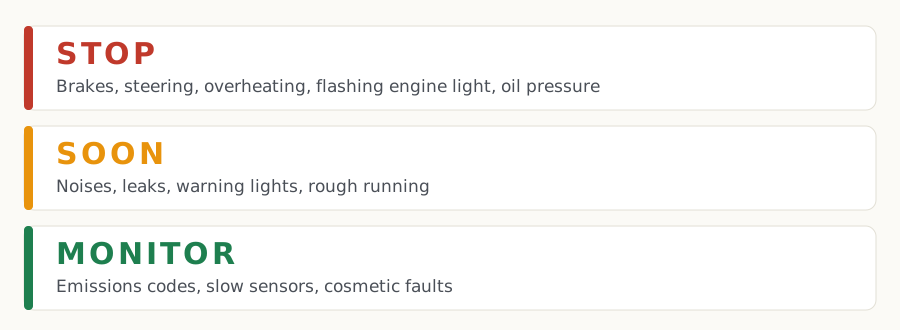
Describe what it’s doing in your own words and the symptom checker gives you a safe-to-drive verdict, ranked causes with costs, and notes to take to the shop — free, no sign-up.
A basic code reader costs around $25 and usually pays for itself the first time a warning light comes on. We compare them in choosing an OBD2 scanner.
Questions people ask
Can a slipping belt strand me?
Yes — that is its endgame. When the belt fails, the alternator stops charging (battery light, then a dead car within roughly an hour of driving) and on many engines the water pump stops (overheating within minutes). A $150 squeal becomes a tow plus whatever the overheat cost.
Why does it squeal only when cold or on full steering lock?
Cold rubber is stiff and grips worst, so a marginal belt slips most in the first minutes. Full steering lock spikes the power-steering pump's load, demanding maximum grip precisely when a worn belt has the least. Both are load tests you're performing by accident.
Belt dressing spray fixed it — am I done?
You silenced it, briefly. Dressing makes the belt sticky, which masks the slip while attracting grit that accelerates wear. It has a place as a diagnostic (if spray stops the squeal, the belt system was the source) but as a fix it is a countdown timer.