Car Won't Start: A Diagnosis You Can Do in the Driveway
A car that will not start is the most stressful common fault, and also one of the most diagnosable without tools. The sound it makes when you turn the key sorts the problem into one of four families in about two seconds, and three of those four families are cheap.
Rapid clicking is a supply problem — usually battery or connections. One loud clunk is the starter. Total silence means the start command never arrived, which points at safety switches, the immobiliser or a completely flat battery. And cranking normally but never firing is a fuel, spark or timing problem, which is the only one that reliably needs a shop.
Why does my car click rapidly but not start?
That machine-gun chatter is the starter solenoid firing and collapsing repeatedly. The battery has just enough energy to close the solenoid, but the instant the starter tries to draw hundreds of amps, voltage collapses, the solenoid releases, and the cycle repeats. It sounds dramatic and it is usually the cheapest possible answer.
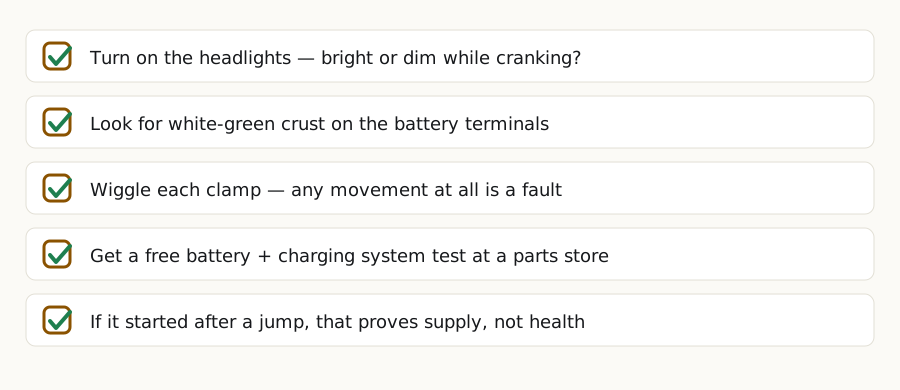
Two suspects: the battery itself, especially if it is four or more summers old, and the terminals. Corroded or loose clamps produce every symptom of a dead battery on a perfectly healthy one, and ten minutes with a wire brush has ended a remarkable number of tow-truck calls. Check both before spending anything, and get the free load test that most parts stores offer.
Why does my car make one loud clunk and not start?
A single firm clunk with the dash lights staying bright means the solenoid closed and held — power delivery is fine — but the starter motor behind it did not turn. That is a starter problem, and the classic field test is to tap the starter body with something solid while someone holds the key; if it fires once, the brushes are worn out and you have bought yourself one last start.
Starter cost varies enormously with access rather than with the part. On some engines it is an hour of labour; on others the intake manifold comes off first. When you get a quote, ask specifically for the labour hours — that number explains most of the difference between quotes for the same car.
Why does nothing happen when I turn the key?
Silence means a broken link in the chain from battery → ignition switch → immobiliser → neutral/clutch safety switch → starter relay. The good news is that most silent no-starts are cheap. Try starting in Neutral rather than Park; wiggle the shifter firmly into Park and try again; on a manual, press the clutch all the way to the floor.
Watch the dash while you turn the key. A flashing key, padlock or car-outline icon is the immobiliser refusing to authorise the start — try your spare key, because a dead fob battery or a cracked transponder chip is a common and cheap answer. And check the starter relay: many fuse boxes contain an identical relay elsewhere that you can swap in for a free two-minute test.
Why does my engine crank but not start?
If the engine spins at normal speed and simply never catches, the electrical side is fine and you are missing fuel, spark, or timing. Turn the key to ON without cranking and listen for a two-second hum from the rear of the car — that is the fuel pump priming. No hum, and the pump or its relay becomes the prime suspect.
The pattern that points at the crankshaft position sensor is worth memorising because it is so specific: the car dies when hot, refuses to start, then starts fine after sitting twenty minutes on the shoulder. That heat-soak behaviour is nearly a signature, and it is one of the most-missed no-start causes because the sensor tests perfectly cold in a workshop bay.
What to tell the shop so you pay for less diagnosis
Diagnostic time is billed by the hour, and the single biggest lever you have on that bill is the quality of the report you give. 'It won't start' buys you an hour of someone reproducing what you already know. 'Rapid clicking, dash lights dim, four-year-old battery, started fine after a jump but was dead again next morning' buys you a targeted test.
Give them four facts: the exact sound, the state of the dash lights, whether anything changed the outcome (Neutral, spare key, jump start), and how it has behaved over the last few days. Those four sentences routinely halve the labour on a no-start diagnosis.
Questions people ask
Rapid clicking versus one loud click — what's the difference?
Rapid clicking is the solenoid re-firing as battery voltage collapses under load: a supply problem, usually battery or terminals. One firm clunk with bright dash lights means the solenoid worked and the starter motor failed to spin. It is the single most useful thing you can tell a shop over the phone.
My car started after a jump. Am I fine now?
Only if something was left on to drain it. Otherwise a jump has proved the battery accepts current, not that it can hold or deliver it. Get the free load test the same day — a battery that needed one unexplained jump usually needs another within the month, somewhere less convenient.
How long should a car battery last?
Typically three to five years, shorter in hot climates because heat kills batteries faster than cold does. Cold weather simply exposes a battery that was already weak: cranking demands more current when it is cold, and a battery that was marginal in August fails in January. If yours is past four summers and behaving oddly, it is a consumable at the end of its life, not a mystery.