Idle is where an engine has no momentum to hide behind. At speed, small imbalances in air, fuel, and spark disappear into the noise; at 700 RPM, every one shows as a shake, a dip, or — at the far end — a stall. That's why so many problems appear “only at idle”: the fault was there all along, and idle is merely where it can't be smoothed over.
The stall matters more than the shake. An engine that dies at a stop takes power-assisted steering and (after a few pedal presses) brake boost with it, and it chooses its moments — the left turn across traffic, the highway off-ramp. A rough idle is a book-it; a stalling engine is a this-week, and the cause list for both is the same list.
What causes rough idle or stalling?
Cost bands are broad US independent-shop estimates, parts and labour. Dealers run higher; your car and region move the numbers.
What can I check myself?
- Note the pattern: rough only at idle but smooth driving (vacuum leak, throttle body), rhythmic like a limp (misfire — get codes read), stalls specifically when stopping or with A/C on (idle-air control).
- Get codes read free — misfire and lean codes turn this page into a two-suspect page.
- Listen near the engine (carefully, nothing loose on you) for a hiss — larger vacuum leaks are audible, and the hiss changes if you briefly cover the leak's area.
- If comfortable, clean the MAF sensor with dedicated MAF cleaner (never carb cleaner) — a legitimate $10 DIY that resolves a real share of these.
What should I tell the mechanic?
- Ask for a smoke test as the first diagnostic if no codes exist — it settles the vacuum-leak question definitively and cheaply.
- Report the exact stall context — stopping, turning, A/C on, cold only — each points at a different subsystem.
- If a throttle body cleaning is done, ask whether an idle relearn procedure applies to your car (many need it, and a skipped relearn looks like the fix failed).
- If parts start being replaced without a narrowing test, pause the job — this symptom family is where guess-and-replace bills grow fastest.
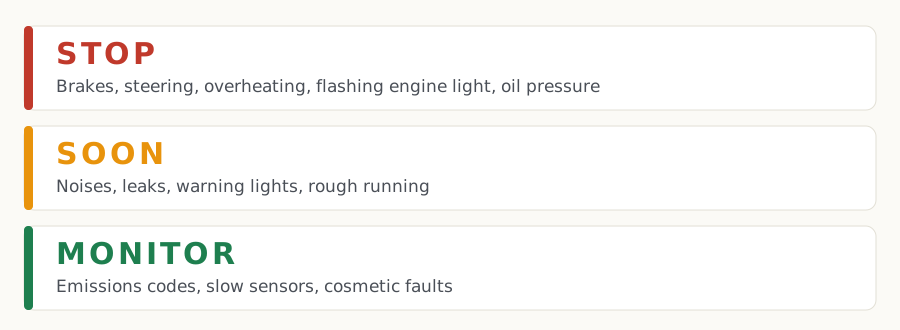
Describe what it’s doing in your own words and the symptom checker gives you a safe-to-drive verdict, ranked causes with costs, and notes to take to the shop — free, no sign-up.
A basic code reader costs around $25 and usually pays for itself the first time a warning light comes on. We compare them in choosing an OBD2 scanner.
Questions people ask
Why does my car idle rough only when cold?
Cold enrichment. The computer runs the mixture richer and the idle higher while warming, which stresses marginal components — a weak coil misfires under the richer cold mixture, then “heals” warm. Cold-only roughness that fully clears is usually ignition or an air metering fault caught at its most demanding moment.
My car stalls when I come to a stop. Why then?
Deceleration is a controlled crash-landing for idle: revs fall fast, the torque converter loads the engine, and the idle control system must catch it at exactly the right airflow. A dirty throttle body or a failing idle control valve catches it late or not at all. That precise symptom — dies while rolling to a stop — points there so reliably it's nearly a part name.
Is stalling dangerous or just annoying?
In a parking lot, annoying. In traffic, dangerous in a specific way: a stalled engine ends power steering assist immediately and brake assist within a few pedal presses, at exactly the moment you're mid-maneuver. The car remains steerable and stoppable — just abruptly heavy. That's why stalling upgrades this whole page's urgency from “book it” to “this week.”