Car Noises: What Every Sound Means and Which Ones Cost You Money
Your car has been talking to you for a while. Most people notice a new noise days or weeks before they act on it, and in that gap the noise usually gets more expensive. Not always — plenty of car sounds are harmless, and knowing which ones is worth real money. But the gap between a squeal and a grind is roughly double the repair bill, and the gap between a tick and a knock can be the engine itself.
This guide sorts every common car noise by what makes it, how urgent it is, and what the repair should cost. The organising principle is simple: a noise is a report about a moving part, and the three questions that identify almost any noise are when does it happen, where does it come from, and does it track engine speed or road speed. Answer those three and you have narrowed a hundred possibilities to two or three.
How do I identify a car noise?
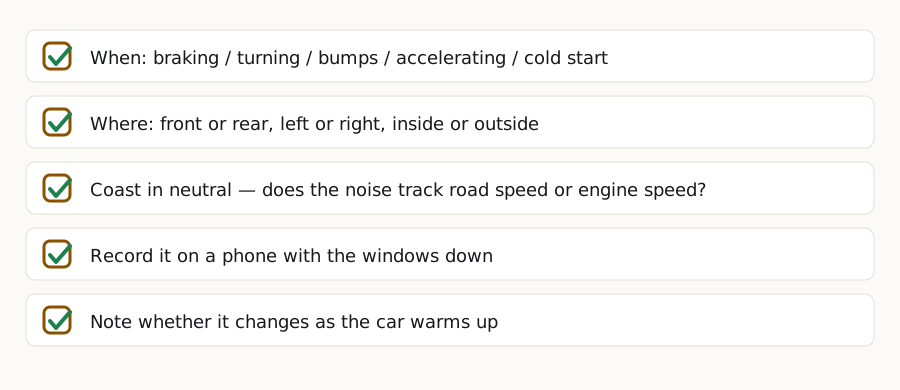
When does it happen? Only when braking, only when turning, only over bumps, only when accelerating, only on cold starts. Each of those brackets a different system. A noise that happens only under braking is a brake noise, full stop — you have already eliminated the engine, the transmission and the tires.
Where does it come from? Front or rear, left or right, low or high, inside the cabin or outside. Passengers are good at this; ask one to listen while you drive. A phone recording with the windows down helps more than most people expect, and a shop will happily listen to it.
Does it track engine speed or road speed? This is the single most useful test in car diagnosis and it costs nothing. Get to the speed where the noise happens, then shift to neutral and coast. If the noise continues unchanged, it is tied to road speed: wheels, tires, bearings, brakes. If it changes or disappears, it is tied to engine speed: belts, pulleys, exhaust, internal engine.
What causes squealing or screeching?
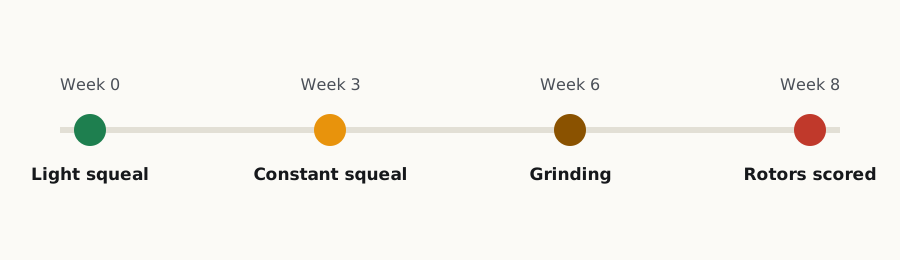
A high, sharp squeal under braking is usually the brake wear indicator — a small steel tab designed to touch the rotor and sing when the pads reach roughly 3 mm. It is not damage. It is a component doing its job, telling you that you have weeks rather than months. Ignore it long enough and it becomes a grind, which is damage.
A squeal that happens on cold starts or when you turn the steering to full lock is almost always the serpentine belt slipping. Cold rubber grips worst, and full steering lock spikes the power steering pump's load — both are accidental load tests on a worn belt. That belt drives the alternator and often the water pump, which is why a $150 squeal becomes a tow when it finally snaps.
What does grinding mean?
Grinding under braking means the friction material is gone and the steel backing plate is machining the rotor. Braking distance is no longer what you expect it to be, and every stop is cutting the disc deeper. This is the one noise on this page that reliably doubles in cost while you think about it: pads-only becomes pads-and-rotors, and occasionally pads-rotors-and-caliper.
Grinding that happens while rolling, whether or not you touch the brakes, is a different animal — usually debris caught in the brake dust shield, sometimes a failed wheel bearing in its final stage. The debris version can cost nothing to fix. The bearing version does not wait politely.
What causes knocking, ticking or tapping?
This is the family that contains the one genuinely frightening noise, so it deserves precision. A deep, hollow knock from low in the engine that speeds up exactly with the tachometer, gets louder as the engine warms, and arrived alongside low oil or an oil-pressure light can be a connecting-rod bearing. That noise means stop driving and call a tow. Minutes of running matter.
Most engine ticking is not that. A light, rapid tick from the top of the engine that is loudest on cold start and fades as oil warms is usually valvetrain noise, and plenty of engines make it for a hundred thousand miles. A metallic rattle that appears only under hard acceleration is spark knock — wrong fuel octane, carbon buildup, or a faulty knock sensor — annoying and worth fixing, but not the emergency.
What causes clunks and rattles over bumps?
Suspension joints are designed to move one way each. When bushings perish or ball joints wear, they gain a second way to move, and every bump slams that slack closed with a clunk. The most common culprit by a wide margin is a sway bar end link: cheap, quick, and responsible for an enormous share of the world's suspension complaints.
The pattern tells you a lot. Clunks over small sharp bumps — expansion joints, washboard surfaces — point at sway bar links. Deeper single clunks over large compressions point at control arm bushings or struts. Clunking that comes with vague steering or a wandering feel raises the priority sharply, because tie rod ends and ball joints are the components in this family that fail suddenly rather than gradually.
What causes humming, droning or growling?
A hum that rises with road speed and changes when you weave gently within your lane is a wheel bearing. The physics is simple: cornering shifts weight onto or off the worn bearing, and the noise responds. Tire noise does not care about a gentle weave, which makes that five-second test the cleanest diagnostic on this page.
A drone that does not respond to weaving is usually the tires — either an aggressive tread pattern doing what it was designed to do, or cupped and scalloped wear from tired shocks or long-ignored imbalance. Worth knowing before you spend on bearings: replacing cupped tires without fixing what cupped them buys the same noise again in ten thousand miles.
Questions people ask
Which car noises mean I should stop driving immediately?
Three: grinding under braking (metal on metal, degraded stopping), a deep knock from the bottom of the engine that tracks engine speed (possible bearing failure), and any noise that arrives with a red warning light, smoke, or a burning smell. Everything else on this page is a book-it-soon rather than a pull-over-now.
Why does my car only make the noise when it's cold?
Cold changes three things: rubber is stiff, oil is thick, and metal clearances are at their widest. Belts slip most when cold, valvetrain ticks loudest before oil pressure builds, and brake surfaces carry overnight moisture. A noise that reliably disappears within the first few minutes is usually in this benign category — though a cold-start rattle that lasts two or three seconds every single time can indicate a stretched timing chain, which is worth a scan.
Can I diagnose a noise from a phone recording?
Partly, and it's more useful than people assume. Record with the windows down, say out loud what you are doing ('braking now', 'turning left'), and capture the same noise twice. Shops are used to these clips. What a recording cannot capture is where the sound is loudest, so pair it with a note about front/rear and left/right.