How Your Car Feels: Shaking, Pulling, Slipping and Soft Pedals
Some faults never make a noise or light. They change how the car feels through the wheel, the pedal and the seat — and because the change is gradual, drivers adapt to it without noticing. People routinely drive for months with a steering wheel that shimmies at 60 mph or a car that needs constant pressure to hold a lane, then discover they have destroyed a set of tires.
Feel-based faults split cleanly by where you notice them. Through the steering wheel means the front of the car. Through the seat and floor means the rear. Through the brake pedal means the hydraulic system or the rotors. Through the accelerator means the drivetrain. This guide walks each one, in the order that saves you the most money.
Why does my car shake at highway speed?
A vibration that appears around 55–70 mph and calms down on either side of that band is the signature of rotating imbalance. Half an ounce of imbalance becomes a hammer at highway rotation speed, and the resonance peaks in that specific window. Where you feel it narrows it further: through the steering wheel means the front wheels, through the seat means the rears.
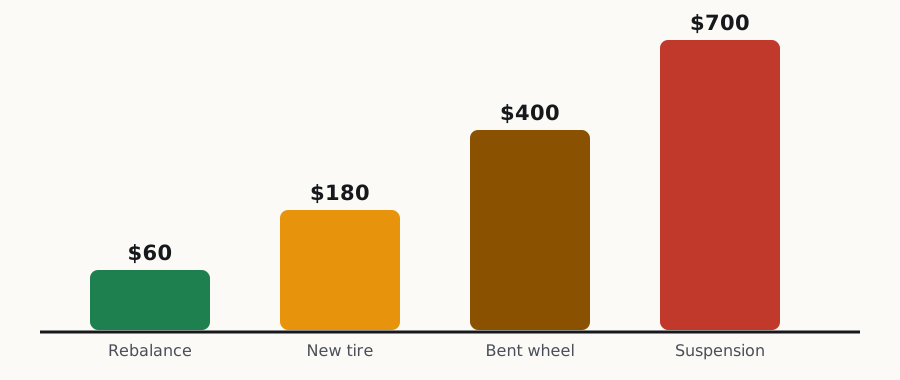
The correct first move is a rebalance, not an alignment. This trips people up constantly: alignment fixes pulling and uneven tire wear; balance fixes vibration. A car can be perfectly aligned and shake violently. Before paying for anything, walk around and run a hand over each tire — scalloped patches mean the imbalance has been there a while, and a sidewall bulge means replace that tire now, not balance it.
Why does my steering wheel pulse when braking?
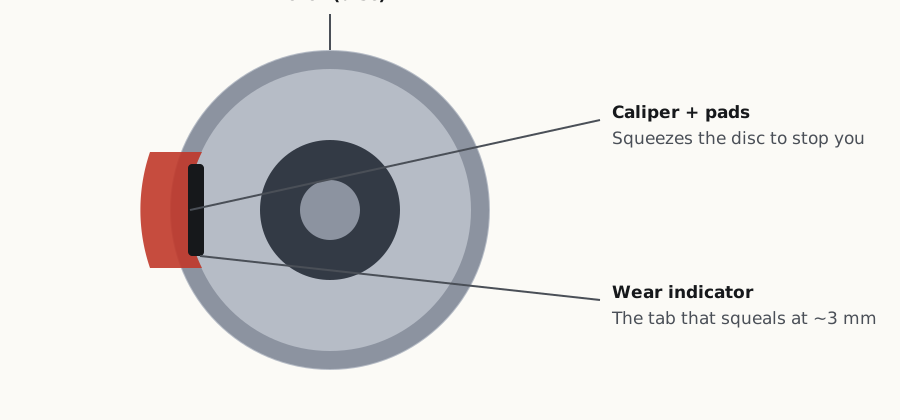
If the shimmy appears specifically under braking and fades when you release, the front rotors have developed thickness variation and the pads are riding over high and low spots dozens of times per second. The popular term is 'warped rotors', but discs almost never warp like a record; what actually happens is uneven pad material transfer or uneven wear.
That distinction matters because it changes the fix. A shop should measure runout and thickness with a gauge — a minute's work — and then offer the honest menu: machine the rotors if enough material remains, replace if not. A quote for replacement without measurement skipped the step that decides whether you needed it, and a pads-only quote for a pulsation complaint has misdiagnosed it outright.
Why does my car pull to one side?
Everyone suspects alignment first. The correct first check is tire pressure, because one front tire 8–10 psi low produces a textbook pull and costs nothing to fix. Set all four to the door-jamb placard — not the number moulded into the tire sidewall, which is a maximum, not a recommendation — and retest.
Two clarifications save real money here. Roads are crowned to shed water, so a gentle drift toward the shoulder on a two-lane road is normal physics; judge a pull only on flat, straight pavement. And a pull that appears only under braking is a different fault — a sticking caliper — with different urgency than a constant pull.
Why is my brake pedal soft or sinking?
This one gets the strictest treatment on the site, and the reason is its failure mode. Worn pads get noisy and progressively worse; hydraulic faults hold at 'mostly fine' right up until they don't. A pedal that travels further than it used to, feels soft, or slowly sinks under steady pressure at a stoplight means the sealed hydraulic column is losing pressure.
Check the reservoir level, look for wet streaks on the inside of the wheels, and note whether pumping firms the pedal up. Then stop driving it. Every other symptom in this guide has a 'book it this week' answer; this one has a tow-truck answer, and a tow costs a fraction of the mildest possible alternative.
Why is my transmission slipping or shifting hard?
When the engine revs without the car matching, or shifts land with a thump, the transmission's hydraulics are the first suspect — and specifically the fluid. Low, burned or ancient fluid produces every one of those symptoms and is the cheapest item on the list by an order of magnitude. On cars with a dipstick this is a two-minute driveway check: fluid should be red-to-pink and nearly odourless, not dark brown and burnt.
The urgency here is specific: every slip drags friction material off the clutch packs, and that debris circulates and grinds everything else. Slipping manufactures its own worsening. Caught early it is often a fluid service and a solenoid; ignored for months, the same fault graduates to a rebuild quote — and that is a repair category where a second opinion from a transmission specialist is worth real money.
Questions people ask
Is it safe to drive a car that shakes at highway speed?
Ordinary imbalance is a wear problem more than an immediate danger — it hammers bearings, bushings and tires every mile, so the $60 fix quietly protects hundreds of dollars of parts. The exception is a sidewall bulge or a tread separation, which can fail suddenly and should be replaced immediately rather than balanced.
Do I need an alignment or a balance?
Balance fixes vibration; alignment fixes pulling and uneven tire wear. They are different services solving different complaints, and shops sometimes sell the wrong one. If your complaint is a speed-band shimmy, ask for balance readings — ideally a road-force balance, which presses a load wheel against the tire and finds internal defects a spin balance misses.
Why does my transmission only act up when it's hot?
Heat thins the fluid, which lowers hydraulic pressure margins, and expands tolerances everywhere — so a marginal clutch or solenoid that holds when cold slips when everything is hot and thin. Hot-only symptoms are classically early-stage, which is genuinely good news: that is the stage where fluid and solenoid fixes still work.